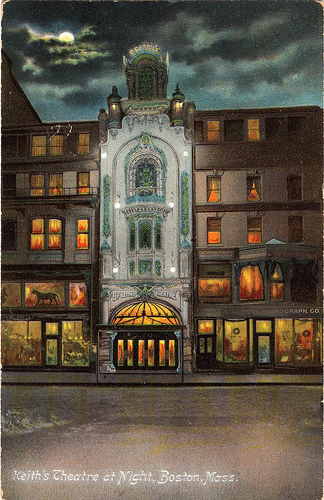
Keith's (New) Theatre
547 Washington Street / Boston, Mass.

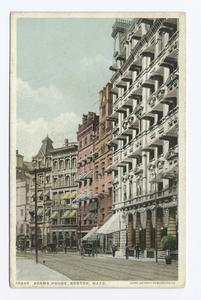
(from CinemaTreasures)
B. F. Keith and E. F. Albee opened B. F. Keith's "New Theatre" on March 24, 1894,
directly behind their Bijou Theatre and next door to their Boston Theatre.
Although it was primarily a vaudeville house during Keith-Albee's ownership,
Thomas Edison demonstrated his new Vitascope movie projector here on May 18, 1896.
After the Keith-Albee partnership replaced their Boston Theatre with the
B.F Keith Memorial Theatre in 1928, they sold this no longer "New" theatre
to the Shubert organization. It reopened on April 1, 1929, as the Apollo Theatre,
but soon changed its name to the Lyric. It later became a movie house, first
called the Normandie and then the Laffmovie.

- Nijou-Normandie entrances, 1939 -
It was demolished in the early 1950s and for many years its former site stood
empty as a parking lot. In 2004, much of that parking lot became a stage extension
and loading docks for the Opera House (the former B.F. Keith Memorial Theatre).
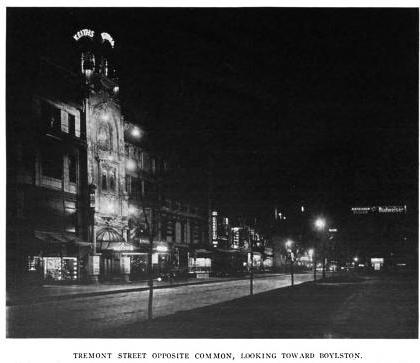
(from Rick Daston's Vaudeville Site)
Vaudeville theatres, often known as "palaces," fiercely competed trying to outdistance
each other in luxury, elegance, and grandiosity. As one journalist wrote at the opening
of B.F. Keith's New Theatre in Boston in 1894:
The age of luxury seems to have reached its ultima thule. The truth of this has never
been impressed upon one so forcibly as in a visit to Keith's dream palace of a theatre...
It is almost incredible that all this elegance should be placed at the disposal of the
public, the poor as well as the rich.
Keith's New Theatre, like F.F. Proctor's Pleasure Palace and many other vaudeville theatres
to come, adapted the excessive and opulent architectural styles of Southern European palaces
to create buildings with few precedents in American cities. The front of Keith's New Theatre
featured a wealth of decorative detail. Wrought iron decorations, stained glass, incandescent
lighting, gargoyles, arches, and marble pillars proclaimed an emphatic message of gentility,
elegance, and success to all passersby. Keith's display continued inside the theatre.
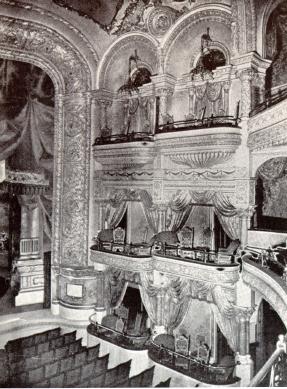
He filled the lobby and foyer with white and green marble, burnished brass, leather upholstered
furniture, large plate mirrors, and enormous panel paintings by the "eminent artist Tojetti."
Keith commissioned Tojetti to create more panel paintings above the huge and heavily gilded
proscenium arch inside the auditorium, complimenting the ornate white and gold balconies,
twelve private boxes, and walls of green and "rich" rose "in a brocaded silk effect."
The design of Keith's New Theatre overlooked nothing. From the elaborate hand-painted ceiling
to "the finest toilet and retiring rooms in the country" to the number oft "fragrant floral
displays," the offering of "the purest artesian well water" and the "writing materials furnished
free--gold pens, sterling silver handles, monogrammed paper and envelopes," Keith's New Theatre
conveyed a feeling of lavish abundance coupled with an inescapable air of refinement. Reportedly,
even the boiler room featured a thick carpets and a whitewashed coal bin.